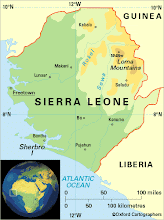
Ok so not actually a real post today, just a quick update. I'm out in Freetown working with a bunch of other volunteers on a Girl's Conference that is to take place in December. All interested volunteers choose 2 female students to take to a conference focused on women's issues and challenges in Sierra Leone. We've been working really hard and could use whatever help anyone can give. Check out the website and please contribute as you are able.
Thanks and I love you guys,
Konya
https://www.peacecorps.gov/index.cfm?shell=donate.contribute.projDetail&projdesc=636-004
If that link doesn't work go to http://www.peacecorps.gov/contribute and search by volunteer last name (for my girl Chrissy Corrigan).
Friday, October 14, 2011

Wednesday, August 31, 2011
525,600 minutes, how do you measure, measure a year?
So I spent a long time trying to pick a theme song for this entry today, probably in large part because its been so long since my last update. I apologize for that, its been a combination of some technical problems at my go to computer location and just a really strange schedule the last few months.
So first why I chose that particular song this time around. In the past few months we (Salone 1) have passed some pretty big milestones. Since the Peace Corps is around a 27 month program there is the one year mark of being in your country (early June), followed by the half way mark overall (early July), finally followed by the one year left mark (August). So obviously all of that results in a lot of reflection about how far you've come and how much you've grown in knowledge of the culture and of yourself. There are some other reasons for choosing the song also. One it reminded me of my SS1 Physics class where we spent a lot of time trying to do unit conversion with questions like How many minutes are in a year? Also Rent has become one of my main workout playlists, sadly mostly on a stationary bike as I've been trying to work my knee back into running shape...as they say here small small (little by little).
So what's happened since the last update?? Well quite a bit as I'm sure you can imagine. We had the third and final term of the school year which was really short. It was already planned to be the shortest term, but my school was also a BECE (Basic Education Certificate Examination) site (the exit exam for middle school), and the only one for like a 20 mile radius. That took over our whole school for the last 3 weeks of the term. So basically we had about 4 weeks of teaching and then cumulative final exams. Not a lot of teaching really since the end of second term. I was really impressed though to hear my fellow teachers speaking up to say that this testing schedule was making it really difficult to teach effectively. That's kind of surprising for me to hear in a place where oftentimes the teachers seem really unmotivated, so it was really great.
A few more words on motivation (why do I feel like that's all I talk about in this blog?). As I've been in my town longer just getting to know people and listening to people, I've noticed more and more the interesting story that is Blama. Blama used to be the most important town in the Eastern Province. My school was widely seen to be the best school in the Eastern Province, Blama was a center of transportation with a main road and railroad junction running through it, and there was a big Lebanese population that had stores and probably did a lot of diamond trading. So it was a pretty big and influential town. Then the railroad became one of many casualties of a government not valuing infrastructure and plagued with corruption. Then chiefdom boundary disputes caused problems. And finally the war came and hit the South-East (where I am) if not harder at least for a more extended period of time than elsewhere in the country since a lot of the conflict was a spillover from Liberia. Lebanese people left and never came back. Buildings were burned, schools and shops looted. People fled and also never came back. All not to mention the more obvious effects of war. And then after it was said and done and the country was peaceful again, all of the rebuilding went to Kenema, which became the district capital and the big town in the Eastern Province. So people from Blama saw the past get destroyed and the future focused 12 miles down the highway and still see reminders everyday of burned out buildings where Lebanese people used to stay, gas stations long abandoned, and a kind of defeated spirit for really understandable reasons. So I completely understand how crazy it is to ask someone to work really hard to rebuild their life in Blama when they feel like betrayed...betrayed by the rebels or the government or whoever, but less specifically betrayed in the way that exists inside of all of us that says really isn't that enough for one person or one town? Haven't we already dealt with enough?
Yeah so those are some of the reasons why its tough to go somewhere and say hey guys lets start building up Blama. Let's work to prepare a better future for Blama...they just can't see it and definitely don't feel like they should be the ones to do it after everything that's happened. That makes life difficult for me because people would much rather see me bring money, bring projects and do all the work then to come alongside me and work together to make things happen. And that is the only effective way to do it, to have people that support you and want to do the project themselves. Most people in Blama just want to live. They don't want people preaching to them all the time about what they should do better to develop their town or country. And there are a lot of great things about living in Blama, if you are not always singularly focused on the "development" of the town. There are football (soccer) clubs that are starting up, Salone artists that come to perform, a thriving Friday market, places to watch Premier League, palm wine "corners" or beer bars, and still the village feel where everyone is friendly and watches out for each other and you don't have to worry about the safety of your kids running around and playing wherever and you can expect random invitations to eat or watch a movie with neighbors or friends. Its not a bad place to live at all, as long as you aren't looking at statistics like how many students are passing their exams or how many thriving business we have that aren't agriculture or petty trading. I get tired of all the preaching about the life that they should be working towards or the development everybody needs to be doing to make Blama a better place. And honestly I am less and less convinced that I am in a position to be giving that advice.
What is it that fundamentally makes America better than other places, in a way that makes it so important for us to "develop" everyone on a path towards ourselves? Don't get me wrong, since being here I appreciate the life and values we live by in America more than ever before. But its been a really big question, what is the overarching goal of this development life? And in a country like Sierra Leone that's overloaded with NGOs, its an important question to ask. I understand that you can give me statistics that make life look pretty rough here. You can check the Human Development Index which will tell you year after year that Sierra Leone is one of the worst places in the world to live. But for what? I started trying to think of how to explain to Americans how ridiculous that idea is for me of measuring the worth of human life by things like average life span, prevalence of corporal punishment, etc.
So this is gonna seem ridiculous but try to stay with me. Since we already know about all the countries of this world here for this example we gotta use a bit of sci-fi and pull in an alternate universe for a second. Like I said, stay with me. Imagine human beings come from an alternate universe to our Earth. Imagine they decide to focus on America first since we are one of the most advanced countries around. Now imagine in their Earth everyone lives to be 200 years old. Imagine the developments in medicine that got them there. One of those developments was to delay childbearing age to begin around 50 for women. Or maybe they use a whole different system for that. They go to school for the first 50 years of their lives. They only sleep one hour a night and work 18 hour days. They spend time with friends once a month, if even that. And they come to America and see the life that we live, and decide that that life is something that should be pitied. Not only something that's different or just not as progressed technologically but something to be fundamentally pitied. And past that they see so many things that we do as ignorant or even immoral, like getting married at 20 or having kids soon after. They think we're lazy for enjoying spending time with friends and only wanting to work 8 hour days.
So the point of that exercise was just to try to get all of you into my head in terms of thinking about what makes life valuable. Nobody is going to come to me and tell me my life isn't valuable or is something that inherently should be pitied because I'm only going to live until like 80 and people still die from cancer and AIDS and things. No, my life is absolutely valuable and so is theirs here. Different yes, full of challenges yes, and there is absolutely room for change and development. But it just seems like we are starting from the absolutely wrong place. Like why is it that we applaud people that adopt children from developing countries and rescue them to America? Yes sometimes that can be a lot better of a life for them and yes I think there are so many amazing things about America and have always been excited to get back home. But we don't know everybody's situation. There are some things about living here that I think are much preferable to our lives in America. There are some friends here that I've looked at and tried to imagine them moving to America and if I felt like their lives would be fundamentally better, and often the answer is no. Not everyone would automatically live a better life by simply being in America. Some people would, but I think its something we assume far too quickly. Length of life does not equal a valuable life. And who are we kidding, everyone is still going to die anyway. Whether its yellow fever at age 40 or cancer at age 50 or a car accident at 17, its going to happen.
Anyway that's my two cents into the life we live as human beings. That said there is a huge advantage to now having spent as much time as I have here. I know enough about the culture to know when I am in a moment that I really love and appreciate and know I'll miss in America, and I can sit in the moment and just really be there. And then on the other hand I can fully acknowledge when I am in a moment that really annoys me and I can think about the fact that not too long from now in America I wont have to deal with that particular issue. So those moments become much easier to get through. And its ok to acknowledge that there are things about living here that will always be difficult or annoying or frustrating. And that doesn't mean that you aren't adjusting or integrating or all of that. It means that life isn't perfect or simple anywhere. It means that every decision and situation has positives and negatives and you deal with it and make the trade-offs and find the balance that works for you.
Ok so enough preaching for today huh? What else has been happening...Since school finished I've been traveling a good deal around the country here (unfortunately right in the rainiest part of the year when the roads are pretty bad) seeing other Peace Corps Volunteers that I hadn't had the chance to visit. I've been working out a good deal and am happy to report that my knee has finally allowed me to run again, and I actually did 8 miles like a week ago (still fighting the rice and palm oil). I've been listening to Salone music as usual, reading books and Time magazine (which I'm addicted to), listening to BBC, eating food. I swear the fact that this country has spicy food, great music, and gorgeous beaches is enough to get me through whatever frustrations I have in life.
Besides that we added 48 new human beings to our Peace Corps Sierra Leone family. The new kids (Salone 2) came in early June and had their training in the North up in Makeni (which is unfortunately a long hard day of travel for me every time I went). I visited them for 4th of July weekend and then went back to work as a Peace Corps Volunteer Resource, to help with their training for almost 2 weeks. Besides that its been medical and training trips to Freetown, of course with beach trips and nights out as is our custom.
So what happens now? School starts again in September (if there isn't a strike due to salary problems) and I'm trying to adjust school stuff to get smaller classes of more motivated students. We'll see if that works, but if it does that'll do wonders to improve my sanity. Oh one of those new Salone 2 human beings got added to my own corner of the world (actually in my town). Because of a weird housing situation I moved across town and he moved into my old house. So we are in a bit of a state of flux out in Blama, but I think it'll be nice to have a new perspective into my town.
Here's to hoping it wont be so long until the next update. I'll be starting up school again and looking forward to December when my mom comes here and then we head out to Ghana. Hope you're all doing well and miss you guys.
Take care,
-A
So first why I chose that particular song this time around. In the past few months we (Salone 1) have passed some pretty big milestones. Since the Peace Corps is around a 27 month program there is the one year mark of being in your country (early June), followed by the half way mark overall (early July), finally followed by the one year left mark (August). So obviously all of that results in a lot of reflection about how far you've come and how much you've grown in knowledge of the culture and of yourself. There are some other reasons for choosing the song also. One it reminded me of my SS1 Physics class where we spent a lot of time trying to do unit conversion with questions like How many minutes are in a year? Also Rent has become one of my main workout playlists, sadly mostly on a stationary bike as I've been trying to work my knee back into running shape...as they say here small small (little by little).
So what's happened since the last update?? Well quite a bit as I'm sure you can imagine. We had the third and final term of the school year which was really short. It was already planned to be the shortest term, but my school was also a BECE (Basic Education Certificate Examination) site (the exit exam for middle school), and the only one for like a 20 mile radius. That took over our whole school for the last 3 weeks of the term. So basically we had about 4 weeks of teaching and then cumulative final exams. Not a lot of teaching really since the end of second term. I was really impressed though to hear my fellow teachers speaking up to say that this testing schedule was making it really difficult to teach effectively. That's kind of surprising for me to hear in a place where oftentimes the teachers seem really unmotivated, so it was really great.
A few more words on motivation (why do I feel like that's all I talk about in this blog?). As I've been in my town longer just getting to know people and listening to people, I've noticed more and more the interesting story that is Blama. Blama used to be the most important town in the Eastern Province. My school was widely seen to be the best school in the Eastern Province, Blama was a center of transportation with a main road and railroad junction running through it, and there was a big Lebanese population that had stores and probably did a lot of diamond trading. So it was a pretty big and influential town. Then the railroad became one of many casualties of a government not valuing infrastructure and plagued with corruption. Then chiefdom boundary disputes caused problems. And finally the war came and hit the South-East (where I am) if not harder at least for a more extended period of time than elsewhere in the country since a lot of the conflict was a spillover from Liberia. Lebanese people left and never came back. Buildings were burned, schools and shops looted. People fled and also never came back. All not to mention the more obvious effects of war. And then after it was said and done and the country was peaceful again, all of the rebuilding went to Kenema, which became the district capital and the big town in the Eastern Province. So people from Blama saw the past get destroyed and the future focused 12 miles down the highway and still see reminders everyday of burned out buildings where Lebanese people used to stay, gas stations long abandoned, and a kind of defeated spirit for really understandable reasons. So I completely understand how crazy it is to ask someone to work really hard to rebuild their life in Blama when they feel like betrayed...betrayed by the rebels or the government or whoever, but less specifically betrayed in the way that exists inside of all of us that says really isn't that enough for one person or one town? Haven't we already dealt with enough?
Yeah so those are some of the reasons why its tough to go somewhere and say hey guys lets start building up Blama. Let's work to prepare a better future for Blama...they just can't see it and definitely don't feel like they should be the ones to do it after everything that's happened. That makes life difficult for me because people would much rather see me bring money, bring projects and do all the work then to come alongside me and work together to make things happen. And that is the only effective way to do it, to have people that support you and want to do the project themselves. Most people in Blama just want to live. They don't want people preaching to them all the time about what they should do better to develop their town or country. And there are a lot of great things about living in Blama, if you are not always singularly focused on the "development" of the town. There are football (soccer) clubs that are starting up, Salone artists that come to perform, a thriving Friday market, places to watch Premier League, palm wine "corners" or beer bars, and still the village feel where everyone is friendly and watches out for each other and you don't have to worry about the safety of your kids running around and playing wherever and you can expect random invitations to eat or watch a movie with neighbors or friends. Its not a bad place to live at all, as long as you aren't looking at statistics like how many students are passing their exams or how many thriving business we have that aren't agriculture or petty trading. I get tired of all the preaching about the life that they should be working towards or the development everybody needs to be doing to make Blama a better place. And honestly I am less and less convinced that I am in a position to be giving that advice.
What is it that fundamentally makes America better than other places, in a way that makes it so important for us to "develop" everyone on a path towards ourselves? Don't get me wrong, since being here I appreciate the life and values we live by in America more than ever before. But its been a really big question, what is the overarching goal of this development life? And in a country like Sierra Leone that's overloaded with NGOs, its an important question to ask. I understand that you can give me statistics that make life look pretty rough here. You can check the Human Development Index which will tell you year after year that Sierra Leone is one of the worst places in the world to live. But for what? I started trying to think of how to explain to Americans how ridiculous that idea is for me of measuring the worth of human life by things like average life span, prevalence of corporal punishment, etc.
So this is gonna seem ridiculous but try to stay with me. Since we already know about all the countries of this world here for this example we gotta use a bit of sci-fi and pull in an alternate universe for a second. Like I said, stay with me. Imagine human beings come from an alternate universe to our Earth. Imagine they decide to focus on America first since we are one of the most advanced countries around. Now imagine in their Earth everyone lives to be 200 years old. Imagine the developments in medicine that got them there. One of those developments was to delay childbearing age to begin around 50 for women. Or maybe they use a whole different system for that. They go to school for the first 50 years of their lives. They only sleep one hour a night and work 18 hour days. They spend time with friends once a month, if even that. And they come to America and see the life that we live, and decide that that life is something that should be pitied. Not only something that's different or just not as progressed technologically but something to be fundamentally pitied. And past that they see so many things that we do as ignorant or even immoral, like getting married at 20 or having kids soon after. They think we're lazy for enjoying spending time with friends and only wanting to work 8 hour days.
So the point of that exercise was just to try to get all of you into my head in terms of thinking about what makes life valuable. Nobody is going to come to me and tell me my life isn't valuable or is something that inherently should be pitied because I'm only going to live until like 80 and people still die from cancer and AIDS and things. No, my life is absolutely valuable and so is theirs here. Different yes, full of challenges yes, and there is absolutely room for change and development. But it just seems like we are starting from the absolutely wrong place. Like why is it that we applaud people that adopt children from developing countries and rescue them to America? Yes sometimes that can be a lot better of a life for them and yes I think there are so many amazing things about America and have always been excited to get back home. But we don't know everybody's situation. There are some things about living here that I think are much preferable to our lives in America. There are some friends here that I've looked at and tried to imagine them moving to America and if I felt like their lives would be fundamentally better, and often the answer is no. Not everyone would automatically live a better life by simply being in America. Some people would, but I think its something we assume far too quickly. Length of life does not equal a valuable life. And who are we kidding, everyone is still going to die anyway. Whether its yellow fever at age 40 or cancer at age 50 or a car accident at 17, its going to happen.
Anyway that's my two cents into the life we live as human beings. That said there is a huge advantage to now having spent as much time as I have here. I know enough about the culture to know when I am in a moment that I really love and appreciate and know I'll miss in America, and I can sit in the moment and just really be there. And then on the other hand I can fully acknowledge when I am in a moment that really annoys me and I can think about the fact that not too long from now in America I wont have to deal with that particular issue. So those moments become much easier to get through. And its ok to acknowledge that there are things about living here that will always be difficult or annoying or frustrating. And that doesn't mean that you aren't adjusting or integrating or all of that. It means that life isn't perfect or simple anywhere. It means that every decision and situation has positives and negatives and you deal with it and make the trade-offs and find the balance that works for you.
Ok so enough preaching for today huh? What else has been happening...Since school finished I've been traveling a good deal around the country here (unfortunately right in the rainiest part of the year when the roads are pretty bad) seeing other Peace Corps Volunteers that I hadn't had the chance to visit. I've been working out a good deal and am happy to report that my knee has finally allowed me to run again, and I actually did 8 miles like a week ago (still fighting the rice and palm oil). I've been listening to Salone music as usual, reading books and Time magazine (which I'm addicted to), listening to BBC, eating food. I swear the fact that this country has spicy food, great music, and gorgeous beaches is enough to get me through whatever frustrations I have in life.
Besides that we added 48 new human beings to our Peace Corps Sierra Leone family. The new kids (Salone 2) came in early June and had their training in the North up in Makeni (which is unfortunately a long hard day of travel for me every time I went). I visited them for 4th of July weekend and then went back to work as a Peace Corps Volunteer Resource, to help with their training for almost 2 weeks. Besides that its been medical and training trips to Freetown, of course with beach trips and nights out as is our custom.
So what happens now? School starts again in September (if there isn't a strike due to salary problems) and I'm trying to adjust school stuff to get smaller classes of more motivated students. We'll see if that works, but if it does that'll do wonders to improve my sanity. Oh one of those new Salone 2 human beings got added to my own corner of the world (actually in my town). Because of a weird housing situation I moved across town and he moved into my old house. So we are in a bit of a state of flux out in Blama, but I think it'll be nice to have a new perspective into my town.
Here's to hoping it wont be so long until the next update. I'll be starting up school again and looking forward to December when my mom comes here and then we head out to Ghana. Hope you're all doing well and miss you guys.
Take care,
-A
Tuesday, April 19, 2011
Fo Peace oh baby i no go ever taya
Ok so this is an awesome Sierra Leone song that is out right now that I love! The translation is pretty straightforward (for peace I'll never tire...something like that, although I can't tell for sure if he is saying peace but whatever). I think the guy is talking about a relationship and telling his girl he’s never gonna get over it or just get tired of the relationship but will stay around. I haven’t heard enough of this song to know for sure because it’s kinda new still, but I’m working on it.
So that's the song of choice this update mostly because the song itself is so fantastic. I realized the other day after going from the Peace Corps 50th Anniversary Open House in Freetown where they were playing 90s music to a small bar near the Peace Corps hostel that was playing local music that I literally will only dance to Salone music now. It is seriously the best dancing music, ever. And I love how everybody here loves it and can just dance forever, doesn't matter if anyone else is around or what's going on, people here are just so happy to be dancing. I've also been trying my hand at learning the songs (with big help from one of the neighbor girls when I don't quite understand the accent or it’s some Krio I don't know yet). I'm trying to live up to my Peace Corps superlative of "lyrical gangsta", or the nickname "musician" that one of the neighbors gave because I enjoy singing so much.
So hanging out with the neighbors listening to music or going to bars or even a few concerts has been some of the best times recently. One of the other volunteers said early on that her 3 favorite things about Sierra Leone were crazy times with the other volunteers, the absolute beauty of the country, and how much music is just a part of every person here from the time they are born. It interesting to see after we've been in the country for a while now how much I agree with those 3 things.
Other updates of what has been going on out here: We just finished second term, which was extended for 3 weeks so that Easter and the 50th Anniversary of Sierra Leone's freedom would fall during break between terms (that’s right, the Peace Corps and Sierra Leone both turn 50 this year). That definitely made sense, although it meant second term was by far the longest term and dragged on towards the end. Interesting things that happened second term: a teacher's strike that was not sanctioned by the Sierra Leone Teacher's Union (SLTU) for about 2 weeks located only in the Eastern Province (and I think only Kenema district). The teacher's strike (among other things) then resulted in the school canceling the annual "sport" (a really big intra-school track and field event) which resulted in really upset students that threatened a strike of their own. My SS3 students took their Core Science WASSCE (West African Senior School Certificate Examination) that is the only indicator of their school performance and requirements for university, and I also helped administer the chemistry practical for the WASSCE. Basically it was busy and ridiculous…
So I've been spending a lot of time recently just thinking about the school system, how it relates to the culture, and how it ended up the way it is. Just to give a brief background, most Peace Corps Volunteers here are frustrated with the school system we find ourselves trying to teach in. And it’s not because of lack of resources or because of large classes, but something more fundamental than that where it seems that they have missed the point of what education is supposed to be. In my mind education is supposed to be a tool to teach people to think in more complex and sophisticated ways and to prepare them to tackle the problems that occur in their own life, not to mention to make them better prepared for the jobs that exist and are important in their country. I've spent a long time trying to think about the disconnect between that and the system we are seeing here. What we see here is a place where students are taught in their third language (students are infinitely more comfortable thinking in their tribal language or in Krio) where it is extremely difficult for them to learn something well enough to solve problems. We see schools where the primary method of teaching is dictation or writing notes directly from the book to the board to the students’ notebooks with no problem solving or original thinking of any kind. We see classes (like my own Chemistry and Physics) that are not actually relevant because there are no jobs in the country except possibly in Freetown that use the skills or knowledge gained from those classes. We see syllabi that are extremely advanced (beyond what is taught in AP classes) with extremely poor pass rates. We see live practicals (labs) conducted for the science exams in a system that expects and even invites corruption because the students have almost no chance of passing without it. And more than anything we see a system that is not resulting in analytical thinking or the ability to solve problems in the students’ lives (and I am not primarily talking about science problems).
All of this together results in a system with pretty low motivation on all sides (both from students and teachers). I've been thinking about this problem of motivation compared to the really impressive (if not somewhat cliche) can-do attitude of the United States that has allowed our country to achieve so much. I have been thinking about how the can-do attitude is built into our culture at every step. Growing up in America everything comes at you in achievable steps, and you learn to trust the system that if you put enough effort into something you will be able to do it. I knew if I studied really hard I could pass my SATs and my AP classes and do well in college. I trusted that the syllabus was designed in a way that was challenging but not out of reach and that teachers were motivated and trained well enough to get me there. Our whole lives we grow up in this place where it is possible to achieve because someone has thought through every step of the process to make sure of that, and there is continual discussion about the appropriate level of challenging our children that will balance high expectations with achievable goals. That is at least until we graduate college, at which point the new challenges can be frustrating but we have a lifetime of education and self confidence to get us half of the way there. That is absolutely not the system here. Even if I work really hard with my best student for the next 2 years and that student puts in all the effort they are able to, I am not convinced that that student can pass the Chemistry or Physics exam. I don't know if I could be motivated in a system like that, so I absolutely understand the lack of motivation that I see here, although it is super frustrating in trying to do my own job. It is also really difficult for me to let go of my own can-do attitude and realize that most or maybe all of my students will not pass, and also that I don't think these subjects are at all relevant to them. I know there are pieces of the subject that are important, like for example how chemistry relates to nutrition or to agriculture, but I cannot justify to myself the chemistry we are teaching these kids here.
So you might want to know a few things at this point: my recommendations and thoughts on how it got this way. Well I don't claim to have answers but I can just let you know what I've been thinking. First recommendations. If I was in charge, I would make school in Krio to give students the chance to actually understand concepts and try to apply them to learn more complex ideas and solve problems. I would change the syllabus to match realities of school here and try to make them more relevant to the students’ lives and the realistic development of the country. For example in math class focus on the math necessary to be a trader, a banker, to start a new business, or as it relates to vocational work. I'd make agriculture class focus on the agriculture that will develop a country and make history focus on the past of Sierra Leone and the choices that it has moving forward as it develops. To give credit where it is due they are doing some of these things and there has been an effort to put emphasis on local situations and local problems, so I definitely want to recognize that.
On to the reason why I think the system is the way it is (and why I won’t actually recommend these really to anyone). I think the school system is a great example of the problems that come from the international community coming with an idea that we think is important and trying to push a country to meet those goals. Education is important. You will never see me argue against that. But there is something that fundamentally doesn’t work when (well meaning) people that don’t exactly understand the situation in a place come and say you should focus on education because it's important, instead of letting the value of education grow organically. It resulted in a system that doesn’t make sense where people do “education” because they are told it’s a good thing to do but they only make a half hearted effort. Basically it resulted in a system that doesn’t work well or produce results. It actually sometimes makes people resentful when they are told to do something because it is “good” and will “develop” the country, then don’t actually see the benefits of it or receive any benefits from it. I understand (somewhat) the motivation of each player in the school system here and how the system managed to be what it is. The students go to school because they’re told it’s important, but school isn’t run well so many aren’t motivated and see it more as a status thing or a time to hang out with friends. The teachers teach but again many aren’t motivated because they don’t truly understand the value of education and the system makes it impossible for them to feel like successful teachers. Also teaching is viewed as the least desirable profession here for a variety of reasons. The parents send their kids to school because everyone tells them it’s important, leaving the parents to do all the hard work (subsistence farming, house work, hard labor stuff, being a trader, etc.) without the children that traditionally would be helping with all of those chores. Most of the parents are not very educated if at all, so they are working super hard to give their children an opportunity that they don’t understand, but unfortunately in a system that doesn’t actually do much for the majority of students. All of this is why it’s so difficult to push an idea that doesn’t just grow organically and then to really get people to understand that idea (and also why it wouldn’t be useful for me to pass along the recommendations…those are ideas they need to get to on their own to ever make any effective or lasting changes). There are similar problems here with democracy and human rights. Again both fantastic ideas and invaluable in making America what it is today. But not something that you can just tell someone how to do or tell them that it is important and they should change their whole system. Both of those ideas here have taken on a really strange shape probably unrecognizable to the people that came trying to pass the ideas.
So being Americans I’m sure you are all asking, so what now? What would be a more effective system? Or am I suggesting that we just leave those ideas behind? Yeah, I’m American so I’m asking those questions too. The problem is I don’t have an answer. Like even a little bit (which as an American and an engineer is absolutely killer). And I’m starting to get convinced that thinking there are answers to every question is also a super American thing that might not actually be real.
Ok so a pretty heavy post today. If you guys are as tired reading it as I am writing it right now, go back to the top and read about music again and let that be your lasting memory from this post :). And if you can try to look up sawa sawa, old firewood, I done fall in love, or the title song for today to find out what I mean. Seriously, the jams here are amazing…
I miss you guys and hope you are all doing well and taking care of yourself. I also wanted to let you all know that while I am thinking about serious stuff I am in no ways unhappy here or regretful of anything. And on those rough days I got my Salone music and the newest anthem of life here “taya taya, I no get fo taya, taya taya, I no get fo taya” (literally I don’t have to tire, but really translated I can push through anything and I’m not gonna get worn out or give up).
Love from Salone,
Konya
So that's the song of choice this update mostly because the song itself is so fantastic. I realized the other day after going from the Peace Corps 50th Anniversary Open House in Freetown where they were playing 90s music to a small bar near the Peace Corps hostel that was playing local music that I literally will only dance to Salone music now. It is seriously the best dancing music, ever. And I love how everybody here loves it and can just dance forever, doesn't matter if anyone else is around or what's going on, people here are just so happy to be dancing. I've also been trying my hand at learning the songs (with big help from one of the neighbor girls when I don't quite understand the accent or it’s some Krio I don't know yet). I'm trying to live up to my Peace Corps superlative of "lyrical gangsta", or the nickname "musician" that one of the neighbors gave because I enjoy singing so much.
So hanging out with the neighbors listening to music or going to bars or even a few concerts has been some of the best times recently. One of the other volunteers said early on that her 3 favorite things about Sierra Leone were crazy times with the other volunteers, the absolute beauty of the country, and how much music is just a part of every person here from the time they are born. It interesting to see after we've been in the country for a while now how much I agree with those 3 things.
Other updates of what has been going on out here: We just finished second term, which was extended for 3 weeks so that Easter and the 50th Anniversary of Sierra Leone's freedom would fall during break between terms (that’s right, the Peace Corps and Sierra Leone both turn 50 this year). That definitely made sense, although it meant second term was by far the longest term and dragged on towards the end. Interesting things that happened second term: a teacher's strike that was not sanctioned by the Sierra Leone Teacher's Union (SLTU) for about 2 weeks located only in the Eastern Province (and I think only Kenema district). The teacher's strike (among other things) then resulted in the school canceling the annual "sport" (a really big intra-school track and field event) which resulted in really upset students that threatened a strike of their own. My SS3 students took their Core Science WASSCE (West African Senior School Certificate Examination) that is the only indicator of their school performance and requirements for university, and I also helped administer the chemistry practical for the WASSCE. Basically it was busy and ridiculous…
So I've been spending a lot of time recently just thinking about the school system, how it relates to the culture, and how it ended up the way it is. Just to give a brief background, most Peace Corps Volunteers here are frustrated with the school system we find ourselves trying to teach in. And it’s not because of lack of resources or because of large classes, but something more fundamental than that where it seems that they have missed the point of what education is supposed to be. In my mind education is supposed to be a tool to teach people to think in more complex and sophisticated ways and to prepare them to tackle the problems that occur in their own life, not to mention to make them better prepared for the jobs that exist and are important in their country. I've spent a long time trying to think about the disconnect between that and the system we are seeing here. What we see here is a place where students are taught in their third language (students are infinitely more comfortable thinking in their tribal language or in Krio) where it is extremely difficult for them to learn something well enough to solve problems. We see schools where the primary method of teaching is dictation or writing notes directly from the book to the board to the students’ notebooks with no problem solving or original thinking of any kind. We see classes (like my own Chemistry and Physics) that are not actually relevant because there are no jobs in the country except possibly in Freetown that use the skills or knowledge gained from those classes. We see syllabi that are extremely advanced (beyond what is taught in AP classes) with extremely poor pass rates. We see live practicals (labs) conducted for the science exams in a system that expects and even invites corruption because the students have almost no chance of passing without it. And more than anything we see a system that is not resulting in analytical thinking or the ability to solve problems in the students’ lives (and I am not primarily talking about science problems).
All of this together results in a system with pretty low motivation on all sides (both from students and teachers). I've been thinking about this problem of motivation compared to the really impressive (if not somewhat cliche) can-do attitude of the United States that has allowed our country to achieve so much. I have been thinking about how the can-do attitude is built into our culture at every step. Growing up in America everything comes at you in achievable steps, and you learn to trust the system that if you put enough effort into something you will be able to do it. I knew if I studied really hard I could pass my SATs and my AP classes and do well in college. I trusted that the syllabus was designed in a way that was challenging but not out of reach and that teachers were motivated and trained well enough to get me there. Our whole lives we grow up in this place where it is possible to achieve because someone has thought through every step of the process to make sure of that, and there is continual discussion about the appropriate level of challenging our children that will balance high expectations with achievable goals. That is at least until we graduate college, at which point the new challenges can be frustrating but we have a lifetime of education and self confidence to get us half of the way there. That is absolutely not the system here. Even if I work really hard with my best student for the next 2 years and that student puts in all the effort they are able to, I am not convinced that that student can pass the Chemistry or Physics exam. I don't know if I could be motivated in a system like that, so I absolutely understand the lack of motivation that I see here, although it is super frustrating in trying to do my own job. It is also really difficult for me to let go of my own can-do attitude and realize that most or maybe all of my students will not pass, and also that I don't think these subjects are at all relevant to them. I know there are pieces of the subject that are important, like for example how chemistry relates to nutrition or to agriculture, but I cannot justify to myself the chemistry we are teaching these kids here.
So you might want to know a few things at this point: my recommendations and thoughts on how it got this way. Well I don't claim to have answers but I can just let you know what I've been thinking. First recommendations. If I was in charge, I would make school in Krio to give students the chance to actually understand concepts and try to apply them to learn more complex ideas and solve problems. I would change the syllabus to match realities of school here and try to make them more relevant to the students’ lives and the realistic development of the country. For example in math class focus on the math necessary to be a trader, a banker, to start a new business, or as it relates to vocational work. I'd make agriculture class focus on the agriculture that will develop a country and make history focus on the past of Sierra Leone and the choices that it has moving forward as it develops. To give credit where it is due they are doing some of these things and there has been an effort to put emphasis on local situations and local problems, so I definitely want to recognize that.
On to the reason why I think the system is the way it is (and why I won’t actually recommend these really to anyone). I think the school system is a great example of the problems that come from the international community coming with an idea that we think is important and trying to push a country to meet those goals. Education is important. You will never see me argue against that. But there is something that fundamentally doesn’t work when (well meaning) people that don’t exactly understand the situation in a place come and say you should focus on education because it's important, instead of letting the value of education grow organically. It resulted in a system that doesn’t make sense where people do “education” because they are told it’s a good thing to do but they only make a half hearted effort. Basically it resulted in a system that doesn’t work well or produce results. It actually sometimes makes people resentful when they are told to do something because it is “good” and will “develop” the country, then don’t actually see the benefits of it or receive any benefits from it. I understand (somewhat) the motivation of each player in the school system here and how the system managed to be what it is. The students go to school because they’re told it’s important, but school isn’t run well so many aren’t motivated and see it more as a status thing or a time to hang out with friends. The teachers teach but again many aren’t motivated because they don’t truly understand the value of education and the system makes it impossible for them to feel like successful teachers. Also teaching is viewed as the least desirable profession here for a variety of reasons. The parents send their kids to school because everyone tells them it’s important, leaving the parents to do all the hard work (subsistence farming, house work, hard labor stuff, being a trader, etc.) without the children that traditionally would be helping with all of those chores. Most of the parents are not very educated if at all, so they are working super hard to give their children an opportunity that they don’t understand, but unfortunately in a system that doesn’t actually do much for the majority of students. All of this is why it’s so difficult to push an idea that doesn’t just grow organically and then to really get people to understand that idea (and also why it wouldn’t be useful for me to pass along the recommendations…those are ideas they need to get to on their own to ever make any effective or lasting changes). There are similar problems here with democracy and human rights. Again both fantastic ideas and invaluable in making America what it is today. But not something that you can just tell someone how to do or tell them that it is important and they should change their whole system. Both of those ideas here have taken on a really strange shape probably unrecognizable to the people that came trying to pass the ideas.
So being Americans I’m sure you are all asking, so what now? What would be a more effective system? Or am I suggesting that we just leave those ideas behind? Yeah, I’m American so I’m asking those questions too. The problem is I don’t have an answer. Like even a little bit (which as an American and an engineer is absolutely killer). And I’m starting to get convinced that thinking there are answers to every question is also a super American thing that might not actually be real.
Ok so a pretty heavy post today. If you guys are as tired reading it as I am writing it right now, go back to the top and read about music again and let that be your lasting memory from this post :). And if you can try to look up sawa sawa, old firewood, I done fall in love, or the title song for today to find out what I mean. Seriously, the jams here are amazing…
I miss you guys and hope you are all doing well and taking care of yourself. I also wanted to let you all know that while I am thinking about serious stuff I am in no ways unhappy here or regretful of anything. And on those rough days I got my Salone music and the newest anthem of life here “taya taya, I no get fo taya, taya taya, I no get fo taya” (literally I don’t have to tire, but really translated I can push through anything and I’m not gonna get worn out or give up).
Love from Salone,
Konya
Friday, February 11, 2011
“With a little ambition just what we could become here…”
Ok so the song this week is Jay Z but is on a tape (yes a tape) that I bought here and work out to in my house, and also describes a lot about how I’ve been feeling recently (more on that later). Ok so the update out here in Sierra Leone…
So we got back from the Christmas break and I had some resolutions (I will not call them New Year’s resolutions but like resolutions for the new term) including exercising regularly (overwhelmingly women gain weight in the Peace Corps because of the increase in carbs and I have sadly not been an exception), eating cereal (quite an expensive habit in Sierra Leone), more protein and fruit and less carbs if possible, and also focusing a lot more energy into my classes and making my classes run well instead of trying to do too many other programs that staff members and other community members weren’t super supportive of anyway. Some changes in the classroom that have actually made class way more effective: a larger focus on classwork with student aides to help correct others’ work, groupwork competitions when I finish a topic to review that topic, optional homework assignments that are more challenging then classwork with optional Saturday help sessions, and an increase in demonstrations and hands on activities whenever possible (this all obviously means slowing down but there is already no chance to finish the syllabus anyway, so might as well make them understand what we do cover). That’s all been working pretty well actually. We started (using all those techniques) doing ionic and covalent bonding in SS2 Chemistry and the students were actually really interested and really motivated. Also the SS1 students got the results from their exams and so have finally joined us at school this term. SS1 Chemistry is over 100 people, which is a challenge every time but has been going better than expected as of right now. Like I said before I’ve been focusing more on making my classes go as well as possible and not focusing on outside activities (which will be explained more below). I also started a school club to talk about Sierra Leone and the United States: similarities, differences, challenges and advantages of living in each country, and having pen pals with US students through the Peace Corps World Wise Schools program.
So that was the update at school until we went on strike about a week and a half ago. The Peace Corps is inherently a non political entity so we have to do our best to not look like we are taking sides, not talk about political things, and just try not to get involved (or even give anyone the option of mistakenly thinking we are involved). Because all teachers are striking I am also not teaching in order to preserve my relationship with my colleagues and my standing in the community. In a nutshell the teachers union has been negotiating with the government for an increase in teachers salaries since the school year started without any changes yet. It is not a country-wide strike and is isolated to Kenema district (where I am placed). I don’t have any idea how long the strike will last so I don’t know when I will be back to work at the school. For now I am just spending time with friends and neighbors, exercising, reading, and hanging out (and trying to get updates without seeming overly involved). So that’s the situation for now.
The other biggest development since IST (In Service Training) in December is just a change in the way I view my role out here. First I am way more accepting that this is my life, these are the challenges, these are my friends, and this is what is going on so I need to fully wrap my head around it and get going. Also I was thinking about my frustrations and trying to pinpoint exactly what it is about Sierra Leone that makes it more challenging fundamentally than being in the United States. Honestly for every ridiculous thing someone does here, there is an equivalent thing that people do in the United States that drives me equally crazy. So what are the big differences? I came up with a few things: 1) The extreme annoyance of people trying to marry you all the time and everything that comes with managing those situations, 2) Having to be culturally sensitive when I see things that I don’t agree with, and 3) Being looked to as a leader and as someone that is supposed to change or “fix” the situation here. It is a completely different task in life to be viewed as someone that has the means and ability and the mandate to fix the problems and to make positive changes in their community. Being in that role makes it so much easier to be extremely frustrated with people and all the ridiculousness of people that I know is just as bad in America as it is here. I feel like it must be similar to being a politician in the United States (at least a politician that is legitimately motivated to make positive changes). So that’s it: being a Peace Corps Volunteer in West Africa is a strange mix of being a politician and a celebrity.
Ok so finally on to the title of this entry and the biggest change really in life out here. After talking to other volunteers and just observing the culture that has formed here (and asking questions and trying to make observations about how it used to be before) you begin to see the challenges in Sierra Leone in a completely different light than you did before or than expected. I think most times when we (Westerners) think about developing countries, we think about places where people have motivation but lack opportunity. I think the problem here is actually more of the opposite. That’s not to say that I think there are as many opportunities here as in the United States, but the problem is much more so with the motivation. And honestly I think a lot of that comes down to the message sent to this country by the rest of the world. It is consistently a message of feeling sorry for the people here, talking about how poor everyone in the country is, and basically doing the opposite of empowering people by creating a system where their best option is to try to get aid instead of making their own way. I actually read in a West African guide book that according to the UN Human Development Index Sierra Leone is (or at least was at the time) the worst place on earth in which to live. I will agree that according to the standards that we are used to in the Western world there are many things (medical care, etc.) where Sierra Leone is not to the level of developed countries. But I don’t think it’s ever useful to phrase it in that way (and yes Sierra Leoneans have heard about that), and I don’t necessarily even think it’s true. Yes life has challenges here but there are challenges everywhere and the views presented also have resulted in a universal acceptance here that everything is perfect for everyone in America, poverty does not exist in America, and basically America is heaven and Sierra Leone is as far to the other side as you will find. The unfortunate outcome of all of that is an extreme “can’t do” attitude and just general low expectations in general for what anyone can hope to accomplish or can expect from other people. There are low expectations for teachers to perform well, for students to do well in class, for people to go through life with the integrity that is necessary to start combating corruption here…and the prevailing attitude is just acceptance of this situation.
I had a discussion with my class about the power of the low expectations in their lives (inspired by an R. Kelly song that says “Just because I am a ghetto child, I wont live down to your expectations"), and told them that from now on my own expectations for them in my class are being raised. I expect them to come on time (and don’t let them in late anymore), I expect them to be respectful (and don’t hesitate to take cell phones and kick people out of class if needed), I will challenge them academically more than anyone else here will and expect them to raise up to that challenge (with the understanding that I am available and here to help them get there), and I expect that some people actually will pass their end of Secondary School exams in my class (to give you an idea in Sierra Leone less than 4% of students passed the Chemistry exam last year…yes less than 4% in the entire country). A majority of the students have responded really well to the challenge and I think that is one of the reasons classes have been much improved this term (before the strike of course). I guess my goal as a Peace Corps Volunteer now in Sierra Leone is to try to show people that they themselves are capable of making positive changes in their own lives. Being a person devoted to motivating others in a place with really low motivation is definitely not an easy task or one where you see an outcome immediately (or ever), but at least now I have a clear understanding of the task and in my mind the goal of being here.
I had a discussion with some teachers at the other secondary school in my town that started as a comparison between living a city life and an agriculturally based village life. We were debating which type of life is better and why, and the challenges and advantages in each life (Blama is definitely in between the two and people can kind of live either life in Blama). After some discussion we decided that neither life is inherently better, and that both have pros and cons and that different people will likely prefer each life. It isn’t a perfect analogy but it led to a discussion comparing life in Sierra Leone to life in America, and I was trying to make a similar argument. I was trying to say that there were pros and cons to each, and that believe it or not there are things about life here and about the culture here that are fantastic and make it at times a better place to live (a radical idea when most people believe America is perfect and their past cultural life like the traditional religion is almost looked down upon), specifically talking about how friendly people are (I will never in my life here worry about being lost because you can ask anyone for help and most times they will even argue with each other over the best advice to give and then take you wherever you are going) and how much time you have to spend with friends, playing games, talking, watching films and football (soccer) games, listening and especially dancing, drinking palm wine, etc. At the end of that discussion we decided one of the worst things that has happened recently in Sierra Leone is the outside world telling them that they are poor and the life they live is something that is to be pitied, and everyone here accepting that view.
So that brings me back to the title: “With a little ambition just what we could become here…”
So I know it was kind of a heavy entry today, but it really has been great to understand so much more of why people act the way they do (not that I am anywhere near knowing everything about that) and how I can try to function inside that to promote positive changes out here.
Ke ta mia,
Konya
So we got back from the Christmas break and I had some resolutions (I will not call them New Year’s resolutions but like resolutions for the new term) including exercising regularly (overwhelmingly women gain weight in the Peace Corps because of the increase in carbs and I have sadly not been an exception), eating cereal (quite an expensive habit in Sierra Leone), more protein and fruit and less carbs if possible, and also focusing a lot more energy into my classes and making my classes run well instead of trying to do too many other programs that staff members and other community members weren’t super supportive of anyway. Some changes in the classroom that have actually made class way more effective: a larger focus on classwork with student aides to help correct others’ work, groupwork competitions when I finish a topic to review that topic, optional homework assignments that are more challenging then classwork with optional Saturday help sessions, and an increase in demonstrations and hands on activities whenever possible (this all obviously means slowing down but there is already no chance to finish the syllabus anyway, so might as well make them understand what we do cover). That’s all been working pretty well actually. We started (using all those techniques) doing ionic and covalent bonding in SS2 Chemistry and the students were actually really interested and really motivated. Also the SS1 students got the results from their exams and so have finally joined us at school this term. SS1 Chemistry is over 100 people, which is a challenge every time but has been going better than expected as of right now. Like I said before I’ve been focusing more on making my classes go as well as possible and not focusing on outside activities (which will be explained more below). I also started a school club to talk about Sierra Leone and the United States: similarities, differences, challenges and advantages of living in each country, and having pen pals with US students through the Peace Corps World Wise Schools program.
So that was the update at school until we went on strike about a week and a half ago. The Peace Corps is inherently a non political entity so we have to do our best to not look like we are taking sides, not talk about political things, and just try not to get involved (or even give anyone the option of mistakenly thinking we are involved). Because all teachers are striking I am also not teaching in order to preserve my relationship with my colleagues and my standing in the community. In a nutshell the teachers union has been negotiating with the government for an increase in teachers salaries since the school year started without any changes yet. It is not a country-wide strike and is isolated to Kenema district (where I am placed). I don’t have any idea how long the strike will last so I don’t know when I will be back to work at the school. For now I am just spending time with friends and neighbors, exercising, reading, and hanging out (and trying to get updates without seeming overly involved). So that’s the situation for now.
The other biggest development since IST (In Service Training) in December is just a change in the way I view my role out here. First I am way more accepting that this is my life, these are the challenges, these are my friends, and this is what is going on so I need to fully wrap my head around it and get going. Also I was thinking about my frustrations and trying to pinpoint exactly what it is about Sierra Leone that makes it more challenging fundamentally than being in the United States. Honestly for every ridiculous thing someone does here, there is an equivalent thing that people do in the United States that drives me equally crazy. So what are the big differences? I came up with a few things: 1) The extreme annoyance of people trying to marry you all the time and everything that comes with managing those situations, 2) Having to be culturally sensitive when I see things that I don’t agree with, and 3) Being looked to as a leader and as someone that is supposed to change or “fix” the situation here. It is a completely different task in life to be viewed as someone that has the means and ability and the mandate to fix the problems and to make positive changes in their community. Being in that role makes it so much easier to be extremely frustrated with people and all the ridiculousness of people that I know is just as bad in America as it is here. I feel like it must be similar to being a politician in the United States (at least a politician that is legitimately motivated to make positive changes). So that’s it: being a Peace Corps Volunteer in West Africa is a strange mix of being a politician and a celebrity.
Ok so finally on to the title of this entry and the biggest change really in life out here. After talking to other volunteers and just observing the culture that has formed here (and asking questions and trying to make observations about how it used to be before) you begin to see the challenges in Sierra Leone in a completely different light than you did before or than expected. I think most times when we (Westerners) think about developing countries, we think about places where people have motivation but lack opportunity. I think the problem here is actually more of the opposite. That’s not to say that I think there are as many opportunities here as in the United States, but the problem is much more so with the motivation. And honestly I think a lot of that comes down to the message sent to this country by the rest of the world. It is consistently a message of feeling sorry for the people here, talking about how poor everyone in the country is, and basically doing the opposite of empowering people by creating a system where their best option is to try to get aid instead of making their own way. I actually read in a West African guide book that according to the UN Human Development Index Sierra Leone is (or at least was at the time) the worst place on earth in which to live. I will agree that according to the standards that we are used to in the Western world there are many things (medical care, etc.) where Sierra Leone is not to the level of developed countries. But I don’t think it’s ever useful to phrase it in that way (and yes Sierra Leoneans have heard about that), and I don’t necessarily even think it’s true. Yes life has challenges here but there are challenges everywhere and the views presented also have resulted in a universal acceptance here that everything is perfect for everyone in America, poverty does not exist in America, and basically America is heaven and Sierra Leone is as far to the other side as you will find. The unfortunate outcome of all of that is an extreme “can’t do” attitude and just general low expectations in general for what anyone can hope to accomplish or can expect from other people. There are low expectations for teachers to perform well, for students to do well in class, for people to go through life with the integrity that is necessary to start combating corruption here…and the prevailing attitude is just acceptance of this situation.
I had a discussion with my class about the power of the low expectations in their lives (inspired by an R. Kelly song that says “Just because I am a ghetto child, I wont live down to your expectations"), and told them that from now on my own expectations for them in my class are being raised. I expect them to come on time (and don’t let them in late anymore), I expect them to be respectful (and don’t hesitate to take cell phones and kick people out of class if needed), I will challenge them academically more than anyone else here will and expect them to raise up to that challenge (with the understanding that I am available and here to help them get there), and I expect that some people actually will pass their end of Secondary School exams in my class (to give you an idea in Sierra Leone less than 4% of students passed the Chemistry exam last year…yes less than 4% in the entire country). A majority of the students have responded really well to the challenge and I think that is one of the reasons classes have been much improved this term (before the strike of course). I guess my goal as a Peace Corps Volunteer now in Sierra Leone is to try to show people that they themselves are capable of making positive changes in their own lives. Being a person devoted to motivating others in a place with really low motivation is definitely not an easy task or one where you see an outcome immediately (or ever), but at least now I have a clear understanding of the task and in my mind the goal of being here.
I had a discussion with some teachers at the other secondary school in my town that started as a comparison between living a city life and an agriculturally based village life. We were debating which type of life is better and why, and the challenges and advantages in each life (Blama is definitely in between the two and people can kind of live either life in Blama). After some discussion we decided that neither life is inherently better, and that both have pros and cons and that different people will likely prefer each life. It isn’t a perfect analogy but it led to a discussion comparing life in Sierra Leone to life in America, and I was trying to make a similar argument. I was trying to say that there were pros and cons to each, and that believe it or not there are things about life here and about the culture here that are fantastic and make it at times a better place to live (a radical idea when most people believe America is perfect and their past cultural life like the traditional religion is almost looked down upon), specifically talking about how friendly people are (I will never in my life here worry about being lost because you can ask anyone for help and most times they will even argue with each other over the best advice to give and then take you wherever you are going) and how much time you have to spend with friends, playing games, talking, watching films and football (soccer) games, listening and especially dancing, drinking palm wine, etc. At the end of that discussion we decided one of the worst things that has happened recently in Sierra Leone is the outside world telling them that they are poor and the life they live is something that is to be pitied, and everyone here accepting that view.
So that brings me back to the title: “With a little ambition just what we could become here…”
So I know it was kind of a heavy entry today, but it really has been great to understand so much more of why people act the way they do (not that I am anywhere near knowing everything about that) and how I can try to function inside that to promote positive changes out here.
Ke ta mia,
Konya
Saturday, December 25, 2010
“Because e no easy eh, ooooooo….”
Ok so this is another Sierra Leonean song (“E Nor Easy”) that sorta represents how things have been lately (and another personal favorite of mine out here…can you tell I like the local music?). The Peace Corps warned us that around 6 months many volunteers experience a dip emotionally, and that definitely has been true for me and some of my good friends here in Sierra Leone. It has been a combination of a lot of things. A lot of us have dealt with some minor but annoying health issues that make it just a bit harder to go about daily life. For me that coincided with running a little low on patience and resulted in a rough period of time. Luckily the term ended not too long after that and I headed out to In Service Training and then to Freetown to celebrate Christmas with some good friends at the beach out here…ya pretty much just in the nick of time. I feel like now I will be going back to my village rejuvenated and hopefully ready to keep on trying to do the best I can do out here.
So let me give you an update with school. I ended up dropping my 3 person SSIII Physics class (the students weren’t coming and we’re offering more classes than they had to anyway) and split my SSII Chemistry class into a more advanced 35 person class and a 60 person class that I move slower with. That strategy has worked fantastically for the 60 person class, and those students are much more engaged and focused in class and learning slowly how to actually solve problems. The advanced class has been acting out a bit and I think I will be working more on group projects and challenging questions with them to try to engage them better. Also the SSI students just came towards the end of the term (they had to wait to get the results of their exit exam from Junior Secondary School) so SSI will be really starting next term. I will have SSI Chemistry (which will be above 100 students) and SSI Physics (likely around 40). It will be a project for me next term to try to gauge the abilities and classroom management situation with that class and try to come up with a strategy for how to manage them.
Also next term I hope to be working on some other projects with my school. I want to slowly incorporate more labs into class and encourage other teachers to do the same. I also want to do a teacher training to help teachers know how to use textbooks as references and to write their own lesson plans. Besides that I am trying to start a girls football (soccer) team and help with the school brass band as time allows. And (you thought I was already busy enough right?) my students are starting correspondence with a school in Illinois through the World Wise Schools program, and I am working with other Peace Corps Volunteers to plan a girls conference for some of our most promising female students. Yeah its gonna be busy…My main focus with all of these projects is to help the school better utilize the resources it already has. One problem that most of the Peace Corps Volunteers have seen is that being in a post-conflict country that is now peaceful means Sierra Leone has gotten a lot of aid and international attention in a very short time period. It seems like that has encouraged a culture of asking for aid (whether monetary or resources from outside) without a lot of thought about whether or not those materials are needed, how they can be used, and who will help to sustain them. What people focus on is how to get more materials, not how to use what is already available. What a country like Sierra Leone really needs (or seems to need right now) is building up the capabilities of the people themselves, with specific emphasis on using the resources that are available in the country or can be sustained without additional resources. All this needs to be done in a way that encourages thinking and discussion about the country holistically, in terms of what type of country Sierra Leone is aspiring to be. The impression we get from people here is that they fully believe that America is a perfect place and exactly what they should aspire to as a country. I personally believe there are many great things about this culture and this country that would be lost in that process, but not a lot of higher level discussion is going on about where the country is going and what that means for the history and future of Sierra Leone.
Ok so I think you can see a bit of where my head has been recently. One thing that has been really valuable about the Peace Corps experience is that I’ve had the time (and just such a drastic change in lifestyle and surroundings) that I can think about big picture things in a way that I never could have if I had never lived outside of the United States. I can see the things that are not perfect about America, but maybe more importantly I can recognize the things I really love about American culture and see my own place in America more clearly. In case you’re wondering I’m still not sure what I will be doing after the Peace Corps but the picture gets clearer as time goes on.
I want to make sure to say that it hasn’t all been frustrations here (and honestly even those frustrations have been tremendous learning experiences). I’ve had some great talks over poyo (palm wine) and Guinness with the local Reverend Father, watched football (English Premier League, go Arsenal!) games with my Mende teacher and some other friends, attended a local dance put on for teachers after the term ended, seen some beautiful scenery (especially a great bike ride recently to Kenema for the day), sang and danced with the neighborhood children a lot(who a former PCV correctly said are the best and worst part of service!), and had some fantastic times with other Peace Corps Volunteers. I mean spending all of Christmas Eve at an empty beach in tropical Africa followed by Christmas lunch and drinks with the US Ambassador and his family? Yeah, things could be worse… :)
Ke ta mia [that is that],
Amanda
So let me give you an update with school. I ended up dropping my 3 person SSIII Physics class (the students weren’t coming and we’re offering more classes than they had to anyway) and split my SSII Chemistry class into a more advanced 35 person class and a 60 person class that I move slower with. That strategy has worked fantastically for the 60 person class, and those students are much more engaged and focused in class and learning slowly how to actually solve problems. The advanced class has been acting out a bit and I think I will be working more on group projects and challenging questions with them to try to engage them better. Also the SSI students just came towards the end of the term (they had to wait to get the results of their exit exam from Junior Secondary School) so SSI will be really starting next term. I will have SSI Chemistry (which will be above 100 students) and SSI Physics (likely around 40). It will be a project for me next term to try to gauge the abilities and classroom management situation with that class and try to come up with a strategy for how to manage them.
Also next term I hope to be working on some other projects with my school. I want to slowly incorporate more labs into class and encourage other teachers to do the same. I also want to do a teacher training to help teachers know how to use textbooks as references and to write their own lesson plans. Besides that I am trying to start a girls football (soccer) team and help with the school brass band as time allows. And (you thought I was already busy enough right?) my students are starting correspondence with a school in Illinois through the World Wise Schools program, and I am working with other Peace Corps Volunteers to plan a girls conference for some of our most promising female students. Yeah its gonna be busy…My main focus with all of these projects is to help the school better utilize the resources it already has. One problem that most of the Peace Corps Volunteers have seen is that being in a post-conflict country that is now peaceful means Sierra Leone has gotten a lot of aid and international attention in a very short time period. It seems like that has encouraged a culture of asking for aid (whether monetary or resources from outside) without a lot of thought about whether or not those materials are needed, how they can be used, and who will help to sustain them. What people focus on is how to get more materials, not how to use what is already available. What a country like Sierra Leone really needs (or seems to need right now) is building up the capabilities of the people themselves, with specific emphasis on using the resources that are available in the country or can be sustained without additional resources. All this needs to be done in a way that encourages thinking and discussion about the country holistically, in terms of what type of country Sierra Leone is aspiring to be. The impression we get from people here is that they fully believe that America is a perfect place and exactly what they should aspire to as a country. I personally believe there are many great things about this culture and this country that would be lost in that process, but not a lot of higher level discussion is going on about where the country is going and what that means for the history and future of Sierra Leone.
Ok so I think you can see a bit of where my head has been recently. One thing that has been really valuable about the Peace Corps experience is that I’ve had the time (and just such a drastic change in lifestyle and surroundings) that I can think about big picture things in a way that I never could have if I had never lived outside of the United States. I can see the things that are not perfect about America, but maybe more importantly I can recognize the things I really love about American culture and see my own place in America more clearly. In case you’re wondering I’m still not sure what I will be doing after the Peace Corps but the picture gets clearer as time goes on.
I want to make sure to say that it hasn’t all been frustrations here (and honestly even those frustrations have been tremendous learning experiences). I’ve had some great talks over poyo (palm wine) and Guinness with the local Reverend Father, watched football (English Premier League, go Arsenal!) games with my Mende teacher and some other friends, attended a local dance put on for teachers after the term ended, seen some beautiful scenery (especially a great bike ride recently to Kenema for the day), sang and danced with the neighborhood children a lot(who a former PCV correctly said are the best and worst part of service!), and had some fantastic times with other Peace Corps Volunteers. I mean spending all of Christmas Eve at an empty beach in tropical Africa followed by Christmas lunch and drinks with the US Ambassador and his family? Yeah, things could be worse… :)
Ke ta mia [that is that],
Amanda
“Mi yay de watch-o, eh-eh-eh mi yay de watch-o, i de watch-o”
This was written at the end of October...just fyi:
Ok so for the first time I’m starting you off with a song in Krio rather than English. It means “My eye is watching, my eye is watching, it is watching”. I’m pretty sure it’s by a Sierra Leonean artist called Innocent, so if you get a chance go check out the song (it’s an awesome and really politically conscious song). Anyway I chose that song today because it pretty much sums up the beginning of the school year for me. Basically the beginning of the year has been me trying things and then watching the students to see if anything I do is actually working.
I knew there would be challenges going into the school year, but I think the challenges are different than I first expected. Or maybe put another way, I thought I would be able to settle into a routine and teaching style quickly that would help me deal with teaching in Sierra Leone, but each class is having unique challenges, and I have to learn what works for each class individually. Let me try to explain. I have a 3 student SSIII Physics class (that have to sit their secondary school exit exam this year), a 25 student SSIII Core Science Physics class (also sitting the exam this year), a 50 student SSII Core Science Physics class (not sitting this year) and a 85+ student SSII Chemistry class. The SSII students are fantastic at sitting and taking notes quietly (in a way that no American class would ever be) because that is the normal class routine here (students don’t have textbooks so class usually consists of taking notes). While they are great at taking notes, they have very little practice actually using their notes to answer questions or solve problems. They also are very difficult to control if you do anything with them at all besides note taking, which is basically all the activities that lead to any real learning. The SSIII’s surprisingly couldn’t be more different. They are bored quickly by note taking and complain often. They are more accustomed to answering questions and will usually try to solve problems, although their math is definitely lacking. They also don’t come to school exams because they think the only score that matters is their exit exam, while the SSII’s have more students on exam day than any other day. So I’ve been spending most of my time revising my teaching ideas and styles to try to fit each class’s needs and capabilities.
I decided on a few areas to focus on with all of my students. I want to get them to understand how to use their notes to answer questions and solve problems, then with time show them how to write their own questions to help study for exams. I want to spend time with them on strategies for reading and understanding exam questions. Finally I want to find a way to get these kids to understand how to use textbooks. We just opened a library this school year that has fantastic physics books and also some decent chemistry books. I was excited at first that students would have books to use and was encouraging them to supplement class with these books, until I realized almost no one has ever used a textbook before and they literally don’t know how to use them. So anyway now you have an idea of my changing school strategies and how things have been going.
The last month and a half has been mostly busy with school, so there isn’t much of an update besides that. I am continuing Mende lessons (oh so slowly making progress there) and continuing to build relationships with community members. I also decided to pay my neighbor to cook for me because cooking is just too much work here, and have really been enjoying eating and spending time with the 3 families that live next to me.
On to more serious issues. First off, just to keep you all updated, we lost 2 more Peace Corps Volunteers to Early Termination, leaving 35 here. As always I wish them luck and hope all is well with them. It is known throughout the Peace Corps that the first 3-6 months at your site are often the most challenging and frustrating, and full of big emotional swings. This is the time many volunteers find it difficult to get anything done and start to wonder why it is that we are really here or what we can honestly accomplish. I have definitely experienced all of those frustrations, and have spent much of my first few months at site thinking about what it is that Peace Corps Volunteers and aid workers in general can actually hope to (or should be striving to) accomplish in Africa. I am far from any sort of answer or even interesting insight on that front, but what has come out of this time is a greater understanding of what characteristics I really value and respect in people (across both cultures). To spare you the details, let me just give you the short list as it stands now: tolerance/open-mindedness, integrity, self-reliance (or at least striving to be able to take care of yourself without relying on others), compassion, and something that I struggle to find a good word for but is basically the opposite of feeling entitled. Something like being able to appreciate the good things in life and the good others do for you. If anyone wants to hear the long winded version of this just let me know and I’d be happy to share :)
To close out today’s update, last time I promised to tell you how I got the travel name “Paradise”. Back during September, the volunteers took a trip to Number 2 River near Freetown. Everyone was discussing travel names that they use outside of their villages just for fun (like Lady Gaga and Iceman just to give some examples) and because we are all tired of being celebrities and hearing our local names yelled at us by children all the time so we welcome using other names when outside of home. Anyway I was still without a travel name when we were heading home from our fantastic 3 days at the beach. We were riding in public transport with 2 Sierra Leoneans and I think 10 volunteers. One of the Sierra Leoneans met one of our volunteers named Evan. He (the Sierra Leonean) turned to me and said “his name is evan [he was thinking Evan’s name was “Heaven” because that’s how you say Heaven in Krio], so my name is el [hell], and you must be paradise?” Later on in the journey the fumes from the car were bothering my eyes and the same Sierra Leonean broke the silence (that is so common in public transport) to say “Paradise is crying”, which in that moment seemed a strangely poetic thing to say. Anyway, that solved the problem of me not having a travel name, and I became Paradise from that point on. I also forgot last time when I gave all my titles to include the Peace Corps Sierra Leone superlative “Lyrical Gangster” I received during training as voted by my peers, so you can add that to the list from last time.
That’s all from Blama, Sierra Leone for now. The next time you hear from me we will have completed the first term of school and I’ll be meeting up with all the remaining Peace Corps Volunteers for In-Service Training (IST), hopefully followed by some sort of outing at some beach somewhere in Sierra Leone…until then I hope all is going well and take care. -A
Ok so for the first time I’m starting you off with a song in Krio rather than English. It means “My eye is watching, my eye is watching, it is watching”. I’m pretty sure it’s by a Sierra Leonean artist called Innocent, so if you get a chance go check out the song (it’s an awesome and really politically conscious song). Anyway I chose that song today because it pretty much sums up the beginning of the school year for me. Basically the beginning of the year has been me trying things and then watching the students to see if anything I do is actually working.
I knew there would be challenges going into the school year, but I think the challenges are different than I first expected. Or maybe put another way, I thought I would be able to settle into a routine and teaching style quickly that would help me deal with teaching in Sierra Leone, but each class is having unique challenges, and I have to learn what works for each class individually. Let me try to explain. I have a 3 student SSIII Physics class (that have to sit their secondary school exit exam this year), a 25 student SSIII Core Science Physics class (also sitting the exam this year), a 50 student SSII Core Science Physics class (not sitting this year) and a 85+ student SSII Chemistry class. The SSII students are fantastic at sitting and taking notes quietly (in a way that no American class would ever be) because that is the normal class routine here (students don’t have textbooks so class usually consists of taking notes). While they are great at taking notes, they have very little practice actually using their notes to answer questions or solve problems. They also are very difficult to control if you do anything with them at all besides note taking, which is basically all the activities that lead to any real learning. The SSIII’s surprisingly couldn’t be more different. They are bored quickly by note taking and complain often. They are more accustomed to answering questions and will usually try to solve problems, although their math is definitely lacking. They also don’t come to school exams because they think the only score that matters is their exit exam, while the SSII’s have more students on exam day than any other day. So I’ve been spending most of my time revising my teaching ideas and styles to try to fit each class’s needs and capabilities.
I decided on a few areas to focus on with all of my students. I want to get them to understand how to use their notes to answer questions and solve problems, then with time show them how to write their own questions to help study for exams. I want to spend time with them on strategies for reading and understanding exam questions. Finally I want to find a way to get these kids to understand how to use textbooks. We just opened a library this school year that has fantastic physics books and also some decent chemistry books. I was excited at first that students would have books to use and was encouraging them to supplement class with these books, until I realized almost no one has ever used a textbook before and they literally don’t know how to use them. So anyway now you have an idea of my changing school strategies and how things have been going.
The last month and a half has been mostly busy with school, so there isn’t much of an update besides that. I am continuing Mende lessons (oh so slowly making progress there) and continuing to build relationships with community members. I also decided to pay my neighbor to cook for me because cooking is just too much work here, and have really been enjoying eating and spending time with the 3 families that live next to me.
On to more serious issues. First off, just to keep you all updated, we lost 2 more Peace Corps Volunteers to Early Termination, leaving 35 here. As always I wish them luck and hope all is well with them. It is known throughout the Peace Corps that the first 3-6 months at your site are often the most challenging and frustrating, and full of big emotional swings. This is the time many volunteers find it difficult to get anything done and start to wonder why it is that we are really here or what we can honestly accomplish. I have definitely experienced all of those frustrations, and have spent much of my first few months at site thinking about what it is that Peace Corps Volunteers and aid workers in general can actually hope to (or should be striving to) accomplish in Africa. I am far from any sort of answer or even interesting insight on that front, but what has come out of this time is a greater understanding of what characteristics I really value and respect in people (across both cultures). To spare you the details, let me just give you the short list as it stands now: tolerance/open-mindedness, integrity, self-reliance (or at least striving to be able to take care of yourself without relying on others), compassion, and something that I struggle to find a good word for but is basically the opposite of feeling entitled. Something like being able to appreciate the good things in life and the good others do for you. If anyone wants to hear the long winded version of this just let me know and I’d be happy to share :)
To close out today’s update, last time I promised to tell you how I got the travel name “Paradise”. Back during September, the volunteers took a trip to Number 2 River near Freetown. Everyone was discussing travel names that they use outside of their villages just for fun (like Lady Gaga and Iceman just to give some examples) and because we are all tired of being celebrities and hearing our local names yelled at us by children all the time so we welcome using other names when outside of home. Anyway I was still without a travel name when we were heading home from our fantastic 3 days at the beach. We were riding in public transport with 2 Sierra Leoneans and I think 10 volunteers. One of the Sierra Leoneans met one of our volunteers named Evan. He (the Sierra Leonean) turned to me and said “his name is evan [he was thinking Evan’s name was “Heaven” because that’s how you say Heaven in Krio], so my name is el [hell], and you must be paradise?” Later on in the journey the fumes from the car were bothering my eyes and the same Sierra Leonean broke the silence (that is so common in public transport) to say “Paradise is crying”, which in that moment seemed a strangely poetic thing to say. Anyway, that solved the problem of me not having a travel name, and I became Paradise from that point on. I also forgot last time when I gave all my titles to include the Peace Corps Sierra Leone superlative “Lyrical Gangster” I received during training as voted by my peers, so you can add that to the list from last time.
That’s all from Blama, Sierra Leone for now. The next time you hear from me we will have completed the first term of school and I’ll be meeting up with all the remaining Peace Corps Volunteers for In-Service Training (IST), hopefully followed by some sort of outing at some beach somewhere in Sierra Leone…until then I hope all is going well and take care. -A
Sunday, September 26, 2010
"This is the life, everyone has to be somewhere. I am here..."
Ok so back to using songs as the title for my blog entries. If you don't recognize that one, it’s from the movie Dangerous Minds. I suggest listening to it or even watching the movie if you want to know why I feel like it describes life at this moment.
As a side note I easily could have called this entry “and then there were 37”, but that’s old news now and isn’t what I want to focus on. It hit me hard at first that another volunteer chose to leave, but I was strangely encouraged when I found out the original Group 1 from 1962 was exactly 37 education volunteers. We always talk about how we are the second version of Group 1 since we are the first volunteers since 1994, so it’s fitting that we have the same amount of volunteers in the same sector.
Ok on to the update. First of all, I’m sorry it has been so long without an update. I’m in my village now and have to travel to a big city to get to internet, and while that isn’t far away, I’ve been thwarted in my last few tries to use the internet (place wasn’t open, not enough time for travel, internet broken, etc.). I’ll try to be updating every month or so from here on out. Also along those lines, I really do want to hear from all of you. I’m sure you probably feel like nothing has changed at home, but it is really exciting to get news from home, even when it seems like something boring or unimportant to you. So please don’t feel shy about sending out a letter or shooting me an email update. I’ll respond back to you using the same method you use.
I have just finished my first month as an official Peace Corps Volunteer. This first month was time before school starts to get “integrated” into your community. That means getting to know people, establishing yourself as a member of the community, trying to learn community strengths and potential community needs (for later secondary projects), preparing for the school year, and whatever else you decide (learning to cook local foods, learning the local language, etc.). I’ve had many conversations with people about how this integration thing is tricky business. First off, in the beginning you are overwhelmed by how much you feel like you need to accomplish, but how little you actually have planned for each day and how to make bring those two things together. I also have the added challenge of being in a big town for a Peace Corps Volunteer at around 10,000 people, which makes it pretty tough to learn “everything there is to know” about this place…
Ok so I won’t keep you in suspense any longer, here are some things I did in this past month:
• I started Mende tutoring with a local middle school Mende teacher. We spent most of Peace Corps Pre-Service Training working on Krio, which is the lingua franca for the country, but the area where I am is heavily Mende speaking (People only really speak Krio for trading or other business ventures and a combination of Mende, Krio, and English at school). The language is coming along very very slowly, but its definitely coming along. Nya gaama Mende yie klo klo (I’m learning the Mende language slowly)…
• I’ve been walking around the town randomly just talking to people and trying to get the town used to the fact that I’m around. That pretty much just means walking down streets, greeting people the best I can in Mende and telling them my name is Konya not pumui (white person), and walking over to spend time with them if they call me over with wa le (please come) or wa mu mehee me (come let us eat). Just fyi, the protocol for eating with people here is to accept it, but eat only a small amount leaving most if not all of the meat, saying you’re fed, and thanking the cook properly.
• “Keeping time” with key people so as to build relationships: my principle and other coworkers, the past Community-Teachers Association (CTA, their version of PTA) chairlady, the police commander and other officers, leaders of the local women’s organization, the town chiefs, the Christian Brothers, Christian Sisters, and Reverend Father at my school, my neighbors, etc.
• Visiting the local Community Health Center and getting an idea of what health care is offered here
• I attempted to start cooking lessons with my neighbor, but it took too much time to go to the market to buy everything, come back, cook, eat, and clean when I was trying to schedule so many other things. Now I pay my neighbor to make me food each day…
• Incredible times with the other volunteers, especially a trip to Number 2 River (where the river meets the beach) near Freetown. First time I’ve stayed in a beach house, danced on the beach, swam and especially watched the sunset over the Atlantic Ocean, and a host of other amazing things…
• Attended a workshop with the local women’s group about gender based violence
• Tagged along with a lady that works on a micro-loan program with women’s groups both in my town and in surrounding villages
• Biked around with one of my coworkers to introduce myself to the surrounding villages
• Continually preparing for school by getting supplies together, reading the Peace Corps guide to classroom management and doing exercises with a coworker, and cleaning, organizing, labeling, and taking inventory for our lab! That’s right we have a lab, with some actual chemicals and glassware
• Working with the Christian Brother on making rules for the new library that is opening at the school, complete with donations of plenty of science books that the students will be able to read inside the library
• Spending time with the “Honourable” (i.e. Parliamentary representative) for these 3 chiefdoms, who is a fantastic woman and one of the few women in government here. I’ve also spent time with the woman who is the head of the 50/50 group for the Eastern Province. That group is based in Freetown and is devoted to increasing the amount of women in Sierra Leonean politics (until its equal or 50/50)
• I’ll round off this list with spending time with the Paramount Chief for my chiefdom. He is a fantastic guy who spent 27 years in America (and got his degrees there) before coming back to Sierra Leone around 2002. We took a trip to Kenema (the district capital 12 miles down the road) and got to meet the Regional Minister (the representative for the President for the whole Eastern Region), district education officials, the LUC (second in command for the Sierra Leone Police in the district, the OC wasn’t around, neither was the mayor who we were also wanting to meet)…the most ridiculous part of that day? Sitting in on the district council meeting where they make actual decisions for the district government. We were invited to the head table and listened to the council debate how much money they would contribute to a scholarship scheme in order to set an example before asking others to contribute. Then they asked my chief if he wanted to speak, and his speech was incredible. He gave me a warm welcome, mentioned that the US isn’t perfect and poor people do exist there (which no one ever believes) but that I did make a sacrifice coming. He went on to say that they should look at my sacrifice and instead of just taking what I have to offer (and trying to marry me while I’m here) they should take me as an example to search within themselves to develop their own country. He said that it should be their goal to decrease foreign aid until it is nothing and Sierra Leone is self-sufficient. He even threw in the JFK quote (super pertinent plus JFK is the founder of the Peace Corps), and I had to try hard not to cry sitting there at the head table (seriously it was way better than I’m making it sound). Mind you this is in stark contrast to how most Sierra Leoneans think. Its too early for me to make broad comments about the culture, but let me tell you a story to get the idea across:
I was keeping time with my Mende teacher talking about how teachers here don’t always get paid, comparing the cost/education system of Sierra Leone and the United States, etc. He started discussing how the government doesn’t do enough for the people (including pay salaries) but had also been complaining about how people shouldn’t be expected to pay taxes because many can’t afford them (taxes here are 5000 Le/year, which is $1.25 although the exchange rate is misleading. The buying power is about 1 meal that could feed a small family of 5 or so). I asked him where the government would get the money without increasing taxes, and without missing a beat (and even shocked that I asked at all) he said “from you people” (Cultural note “you people” is common and not at all an offensive thing to say, even though it sounds weird to us). Again its too early for me to be making cultural judgments, but the huge NGO presence in Sierra Leone is definitely doing something to develop a culture where people expect others (especially foreigners and the government) to come in and do things for them, don’t think they can/don’t want to do it for themselves, and take very little initiative in their own country’s development…now you see why the chief’s speech to a decision making body was so moving to me.
Since I don’t want to be making broad cultural statements, and I feel its too early to be saying extremely insightful things about the meaning of life or the inherent flaws in America (just kidding, just kidding), let me close off this long entry with some interesting things that people say in Sierra Leonean English or in Krio that are just ridiculous to me, and their “cultural interpretation”.
First off, there is definitely the mark of British English on Sierra Leonean English, especially in words that sound extremely formal to me like veranda, parlor, vex, and humbug. There are also words that mean something different than how we use them, and it is a debate among volunteers whether the differences come from British English or the African interpretation, like using “revision” instead of “review”, sayings like “I want to believe”, or the hardest one for me to get used to: when people use “can” to mean “do”. For example if someone says “can you eat rice?” it means do you usually eat rice, or if someone says “why can’t you go sit inside?” it is really just a suggestion, not the attack it sounds like in American English. Some other funny things people say in Krio: most greetings start with asking someone “aw di bodi?” (how is the body?), “aw yu slip?” (how did you sleep?), or “aw yu spend di de?” (how did you spend the day? – the answer to this is “fine”, not a list of what you did that day), all of which are pretty weird to us. Last but not least, and definitely one of my favorites is “how do you see the environment?” Upon first hearing this, all the volunteers wanted to answer something along the lines of “with my eyes”, but the question is closer to “what do you think about the environment?” so the answer is whatever you are thinking about the place that you’re in.
Anyway let me finish off this long long entry with a little glimpse into what’s coming ahead. School officially “re-opened” on the 13th of September, but students file in slowly for the first week or two, so I’m just hanging out at the school in my awesome African lapa suits spending time with teachers, learning about how things run in the school, making other preparations, and “reviewing” material with the small number of students who have actually come…By next time you’ll be hearing from someone who has actually been teaching her official African classes! Well I want to believe I will be teaching by then…
In another side note, I realized recently that I am now living by myself for the first time in my life. Its strange to think that I passed this important milestone while in Africa…
Ok, in the truly Sierra Leonean way, let me sign off with all my relevant titles:
Amanda Pease
Konya Dongboi (Mende name)
Paradise (travel name, I promise to explain this one next time)
Peace Corps Volunteer, Sierra Leone group 1.2
Volunteer Advisory Committee (VAC) representative
Peer Support Network Counselor
And I’m sure many more to come once school gets going and we settle into our committees at school: I’m guessing I’ll be in the Library Committee, Sports Committee, and Performing Arts Committee to start…
Or in my standard American way of signing off:
Take care,
-A
As a side note I easily could have called this entry “and then there were 37”, but that’s old news now and isn’t what I want to focus on. It hit me hard at first that another volunteer chose to leave, but I was strangely encouraged when I found out the original Group 1 from 1962 was exactly 37 education volunteers. We always talk about how we are the second version of Group 1 since we are the first volunteers since 1994, so it’s fitting that we have the same amount of volunteers in the same sector.
Ok on to the update. First of all, I’m sorry it has been so long without an update. I’m in my village now and have to travel to a big city to get to internet, and while that isn’t far away, I’ve been thwarted in my last few tries to use the internet (place wasn’t open, not enough time for travel, internet broken, etc.). I’ll try to be updating every month or so from here on out. Also along those lines, I really do want to hear from all of you. I’m sure you probably feel like nothing has changed at home, but it is really exciting to get news from home, even when it seems like something boring or unimportant to you. So please don’t feel shy about sending out a letter or shooting me an email update. I’ll respond back to you using the same method you use.
I have just finished my first month as an official Peace Corps Volunteer. This first month was time before school starts to get “integrated” into your community. That means getting to know people, establishing yourself as a member of the community, trying to learn community strengths and potential community needs (for later secondary projects), preparing for the school year, and whatever else you decide (learning to cook local foods, learning the local language, etc.). I’ve had many conversations with people about how this integration thing is tricky business. First off, in the beginning you are overwhelmed by how much you feel like you need to accomplish, but how little you actually have planned for each day and how to make bring those two things together. I also have the added challenge of being in a big town for a Peace Corps Volunteer at around 10,000 people, which makes it pretty tough to learn “everything there is to know” about this place…
Ok so I won’t keep you in suspense any longer, here are some things I did in this past month:
• I started Mende tutoring with a local middle school Mende teacher. We spent most of Peace Corps Pre-Service Training working on Krio, which is the lingua franca for the country, but the area where I am is heavily Mende speaking (People only really speak Krio for trading or other business ventures and a combination of Mende, Krio, and English at school). The language is coming along very very slowly, but its definitely coming along. Nya gaama Mende yie klo klo (I’m learning the Mende language slowly)…
• I’ve been walking around the town randomly just talking to people and trying to get the town used to the fact that I’m around. That pretty much just means walking down streets, greeting people the best I can in Mende and telling them my name is Konya not pumui (white person), and walking over to spend time with them if they call me over with wa le (please come) or wa mu mehee me (come let us eat). Just fyi, the protocol for eating with people here is to accept it, but eat only a small amount leaving most if not all of the meat, saying you’re fed, and thanking the cook properly.
• “Keeping time” with key people so as to build relationships: my principle and other coworkers, the past Community-Teachers Association (CTA, their version of PTA) chairlady, the police commander and other officers, leaders of the local women’s organization, the town chiefs, the Christian Brothers, Christian Sisters, and Reverend Father at my school, my neighbors, etc.
• Visiting the local Community Health Center and getting an idea of what health care is offered here
• I attempted to start cooking lessons with my neighbor, but it took too much time to go to the market to buy everything, come back, cook, eat, and clean when I was trying to schedule so many other things. Now I pay my neighbor to make me food each day…
• Incredible times with the other volunteers, especially a trip to Number 2 River (where the river meets the beach) near Freetown. First time I’ve stayed in a beach house, danced on the beach, swam and especially watched the sunset over the Atlantic Ocean, and a host of other amazing things…
• Attended a workshop with the local women’s group about gender based violence
• Tagged along with a lady that works on a micro-loan program with women’s groups both in my town and in surrounding villages
• Biked around with one of my coworkers to introduce myself to the surrounding villages
• Continually preparing for school by getting supplies together, reading the Peace Corps guide to classroom management and doing exercises with a coworker, and cleaning, organizing, labeling, and taking inventory for our lab! That’s right we have a lab, with some actual chemicals and glassware
• Working with the Christian Brother on making rules for the new library that is opening at the school, complete with donations of plenty of science books that the students will be able to read inside the library
• Spending time with the “Honourable” (i.e. Parliamentary representative) for these 3 chiefdoms, who is a fantastic woman and one of the few women in government here. I’ve also spent time with the woman who is the head of the 50/50 group for the Eastern Province. That group is based in Freetown and is devoted to increasing the amount of women in Sierra Leonean politics (until its equal or 50/50)
• I’ll round off this list with spending time with the Paramount Chief for my chiefdom. He is a fantastic guy who spent 27 years in America (and got his degrees there) before coming back to Sierra Leone around 2002. We took a trip to Kenema (the district capital 12 miles down the road) and got to meet the Regional Minister (the representative for the President for the whole Eastern Region), district education officials, the LUC (second in command for the Sierra Leone Police in the district, the OC wasn’t around, neither was the mayor who we were also wanting to meet)…the most ridiculous part of that day? Sitting in on the district council meeting where they make actual decisions for the district government. We were invited to the head table and listened to the council debate how much money they would contribute to a scholarship scheme in order to set an example before asking others to contribute. Then they asked my chief if he wanted to speak, and his speech was incredible. He gave me a warm welcome, mentioned that the US isn’t perfect and poor people do exist there (which no one ever believes) but that I did make a sacrifice coming. He went on to say that they should look at my sacrifice and instead of just taking what I have to offer (and trying to marry me while I’m here) they should take me as an example to search within themselves to develop their own country. He said that it should be their goal to decrease foreign aid until it is nothing and Sierra Leone is self-sufficient. He even threw in the JFK quote (super pertinent plus JFK is the founder of the Peace Corps), and I had to try hard not to cry sitting there at the head table (seriously it was way better than I’m making it sound). Mind you this is in stark contrast to how most Sierra Leoneans think. Its too early for me to make broad comments about the culture, but let me tell you a story to get the idea across:
I was keeping time with my Mende teacher talking about how teachers here don’t always get paid, comparing the cost/education system of Sierra Leone and the United States, etc. He started discussing how the government doesn’t do enough for the people (including pay salaries) but had also been complaining about how people shouldn’t be expected to pay taxes because many can’t afford them (taxes here are 5000 Le/year, which is $1.25 although the exchange rate is misleading. The buying power is about 1 meal that could feed a small family of 5 or so). I asked him where the government would get the money without increasing taxes, and without missing a beat (and even shocked that I asked at all) he said “from you people” (Cultural note “you people” is common and not at all an offensive thing to say, even though it sounds weird to us). Again its too early for me to be making cultural judgments, but the huge NGO presence in Sierra Leone is definitely doing something to develop a culture where people expect others (especially foreigners and the government) to come in and do things for them, don’t think they can/don’t want to do it for themselves, and take very little initiative in their own country’s development…now you see why the chief’s speech to a decision making body was so moving to me.
Since I don’t want to be making broad cultural statements, and I feel its too early to be saying extremely insightful things about the meaning of life or the inherent flaws in America (just kidding, just kidding), let me close off this long entry with some interesting things that people say in Sierra Leonean English or in Krio that are just ridiculous to me, and their “cultural interpretation”.
First off, there is definitely the mark of British English on Sierra Leonean English, especially in words that sound extremely formal to me like veranda, parlor, vex, and humbug. There are also words that mean something different than how we use them, and it is a debate among volunteers whether the differences come from British English or the African interpretation, like using “revision” instead of “review”, sayings like “I want to believe”, or the hardest one for me to get used to: when people use “can” to mean “do”. For example if someone says “can you eat rice?” it means do you usually eat rice, or if someone says “why can’t you go sit inside?” it is really just a suggestion, not the attack it sounds like in American English. Some other funny things people say in Krio: most greetings start with asking someone “aw di bodi?” (how is the body?), “aw yu slip?” (how did you sleep?), or “aw yu spend di de?” (how did you spend the day? – the answer to this is “fine”, not a list of what you did that day), all of which are pretty weird to us. Last but not least, and definitely one of my favorites is “how do you see the environment?” Upon first hearing this, all the volunteers wanted to answer something along the lines of “with my eyes”, but the question is closer to “what do you think about the environment?” so the answer is whatever you are thinking about the place that you’re in.
Anyway let me finish off this long long entry with a little glimpse into what’s coming ahead. School officially “re-opened” on the 13th of September, but students file in slowly for the first week or two, so I’m just hanging out at the school in my awesome African lapa suits spending time with teachers, learning about how things run in the school, making other preparations, and “reviewing” material with the small number of students who have actually come…By next time you’ll be hearing from someone who has actually been teaching her official African classes! Well I want to believe I will be teaching by then…
In another side note, I realized recently that I am now living by myself for the first time in my life. Its strange to think that I passed this important milestone while in Africa…
Ok, in the truly Sierra Leonean way, let me sign off with all my relevant titles:
Amanda Pease
Konya Dongboi (Mende name)
Paradise (travel name, I promise to explain this one next time)
Peace Corps Volunteer, Sierra Leone group 1.2
Volunteer Advisory Committee (VAC) representative
Peer Support Network Counselor
And I’m sure many more to come once school gets going and we settle into our committees at school: I’m guessing I’ll be in the Library Committee, Sports Committee, and Performing Arts Committee to start…
Or in my standard American way of signing off:
Take care,
-A
Subscribe to:
Posts (Atom)